
Selection Criteria Writer
Write Winning Selection Criteria Responses with AI
Selection criteria are the number one reason great candidates never finish their government job application. AI Resume Craft turns your real experience into structured, STAR-method responses in minutes — not a whole weekend.
airesumecraft.com
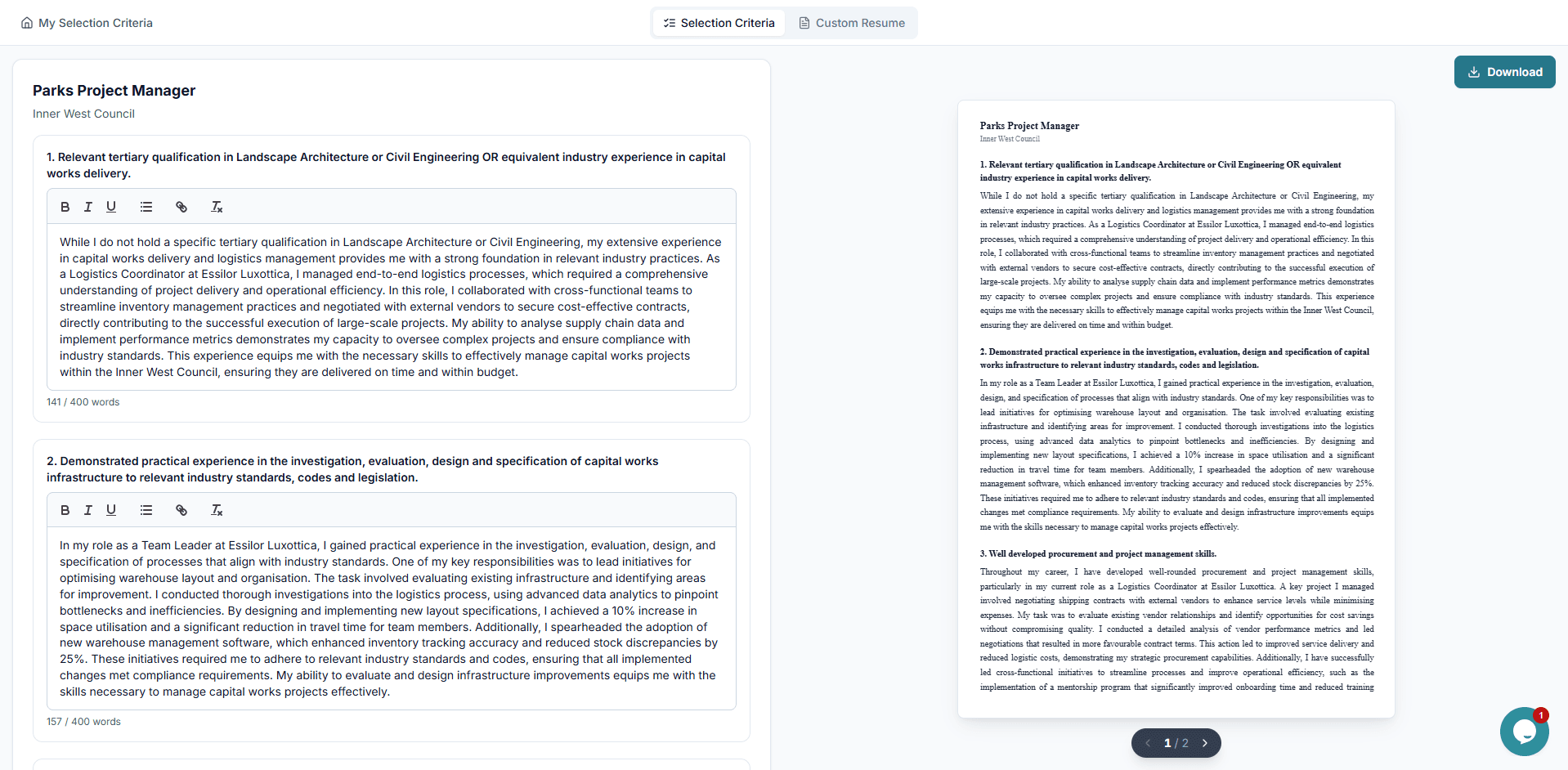
From Blank Page to Submitted Response
Tell us what the panel is asking for and what you've actually done — the AI handles the structure.
What Are Selection Criteria?
Selection criteria — often called key selection criteria or KSC — are the specific skills, knowledge, and experience an employer requires for a role. They're standard practice across Australian government hiring: federal (APS), state and territory departments, local councils, public health, education, and emergency services. Instead of relying on your resume alone, panels ask you to write a short statement proving you meet each criterion, and those statements are what actually get you shortlisted.
The STAR Method, With a Worked Example
Every response our AI drafts follows STAR — Situation, Task, Action, Result — because that's the structure hiring panels are trained to look for.
Example criterion: "Demonstrated ability to build and maintain productive working relationships with a range of stakeholders."
S
Situation
In my previous role coordinating a community outreach program, I worked with a mix of internal teams, local council staff, and volunteer groups who often had competing priorities and limited time to meet.
T
Task
I needed to keep every stakeholder informed and aligned so the program stayed on schedule, without adding meetings to already full calendars.
A
Action
I set up a fortnightly written update circulated to all stakeholder groups, ran short one-on-one check-ins with the two council contacts who preferred direct conversation, and created a shared document so volunteers could raise issues without waiting for a meeting.
R
Result
Stakeholder response times improved noticeably, two scheduling conflicts were resolved before they affected the program, and the council extended the partnership for a second year, citing the clarity of communication as a key reason.
Your own response is built the same way — from your own situation, task, action, and result — not this one.
Built for Australian Public Sector Applications
Selection criteria show up across every corner of Australia's public sector.
Your Experience, Not the AI's Imagination
The tool drafts from the situation, task, action, and result you give it — it doesn't invent achievements for you. Always review, fact-check, and personalise your draft before you submit it. A selection criteria response you can't speak to confidently in an interview does you more harm than good.
See Worked Examples by Role
Browse fully worked STAR-method responses for APS levels, nursing, teaching, police, council, and project roles.
Browse Selection Criteria ExamplesSelection Criteria FAQs
Everything you need to know about writing selection criteria responses with AI Resume Craft.
Key selection criteria are the specific skills, knowledge, and experience an employer — almost always a government or public sector employer in Australia — lists as requirements for a role. Applicants are asked to provide a written statement addressing each criterion, and hiring panels use these responses, alongside your resume, to decide who gets shortlisted for interview.
STAR stands for Situation, Task, Action, Result. It's a structure for answering selection criteria (and interview questions) with a real example: describe the Situation you were in, the Task you needed to achieve, the Actions you took, and the Result you achieved. Panels are trained to look for this structure because it proves your claim with evidence rather than just asserting a skill.
Most government job ads specify a limit, commonly 250–500 words per criterion, though some agencies ask for a single combined pitch instead of criterion-by-criterion responses. Always follow the word limit stated in the job ad or application instructions — panels can and do disregard content over the limit.
Most Australian government agencies don't prohibit using AI tools to help draft your application, but every agency expects the final submission to accurately reflect your own skills and experience — and some application forms require you to declare this. Use AI Resume Craft to structure a first draft from your real experience, then review, fact-check, and personalise it before you submit.