AI Cover Letter Generator
Paste the Job Ad. Get a Tailored Cover Letter.
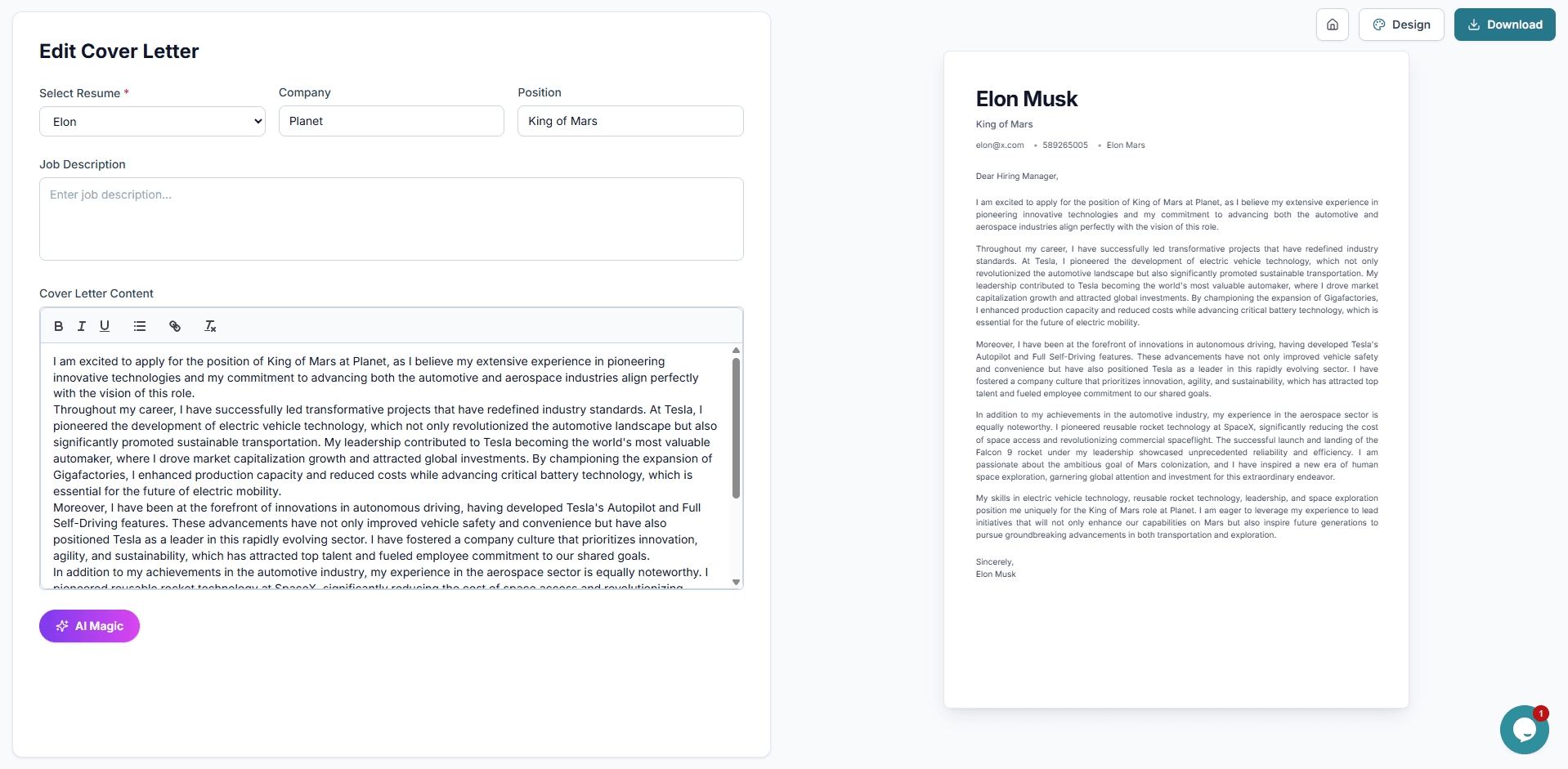
Drop in a job description and your background, and AI Resume Craft drafts a cover letter that speaks directly to that role — not a generic template with your name swapped in.
airesumecraft.com
How It Works
Generic vs. Tailored: The Difference One Sentence Makes
An illustrative example of what "tailored" actually looks like in practice.
Generic opening
"I am writing to apply for the position at your company. I believe I would be a good fit and have relevant experience in this field."
Tailored opening
"Your listing for a Marketing Coordinator at [Company] asks for someone who can run campaigns end-to-end — over the past two years I've done exactly that, managing a $40k annual budget across five channels and lifting campaign response rates by 18%."
The generic version could be sent to any employer for any job — and reads that way. The tailored version references the exact job title, names the company, and backs up the claim with a specific number instead of asking the reader to take "good fit" on faith. That's the difference the generator is built to produce automatically, every time, without you having to hand-write a new opening for every application.
Tone and Length, Under Your Control
A cover letter for a corporate finance role and a cover letter for a creative agency shouldn't sound the same — so the generator doesn't force one voice on every application. Set the tone toward formal and precise for traditional industries and government roles, or warmer and more conversational for smaller companies and creative fields, and set the target length so the letter fits what the employer actually asked for — some ads specify "no more than one page," others don't mention it at all.
FormalConversational
Length
ShortStandardLong
What a Good Australian Cover Letter Contains
Australian employers generally expect a cover letter to be short — around half a page to one page — and to do three things: show you've read the job ad properly, connect your actual experience to what the role needs, and explain briefly why you want to work for that specific employer.
Opening
References the role and company by name and states, in one sentence, why you're a strong fit — a hook, not a restatement of your resume.
Middle
One or two short paragraphs connecting your most relevant achievements to the job ad's requirements, backed by a number or concrete result.
Closing
A brief line on why the role appeals to you, a note that your resume is attached, and a simple call to action.
Avoid restating your entire resume, avoid generic filler about being a "hard worker" without evidence, and keep formatting simple: no graphics, no unusual fonts, just clear paragraphs an employer — or an ATS — can read quickly.
Pair It With a Tailored Resume
Your cover letter and resume work best together — build both from the same profile.
Write My Cover Letter — FreeSee the Resume BuilderCover Letter FAQs
Common questions about generating a cover letter with AI Resume Craft.
Ideally, yes — a cover letter that references the specific role and company reads as far more genuine than one that could have been sent to anyone. That's exactly what the generator is for: paste in a new job ad and get a letter built around that role in seconds, instead of rewriting one from scratch each time.
Yes. You can adjust the tone from formal and corporate through to warmer and more conversational, and set the target length, so the letter fits the industry and role you're applying for.
Many employers still read them, especially for roles that ask for one explicitly or for competitive positions where a generic application won't stand out. If a job ad doesn't request a cover letter and doesn't leave anywhere to attach one, you can generally skip it — otherwise, a short, tailored letter rarely hurts your application.
Yes. The generator uses the same profile information as your resume, so your cover letter and resume tell a consistent story instead of contradicting each other.